 Chat with Us

Modern Technologies Used in Two-Way Radios Today
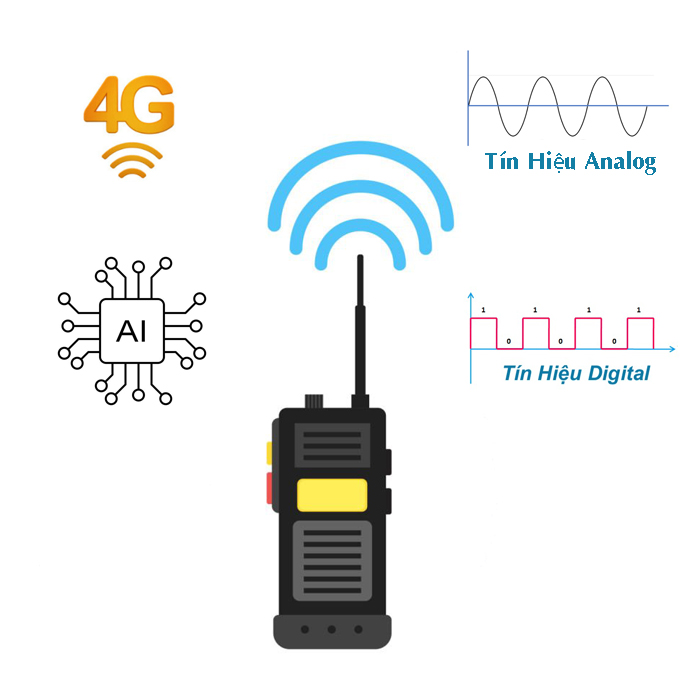
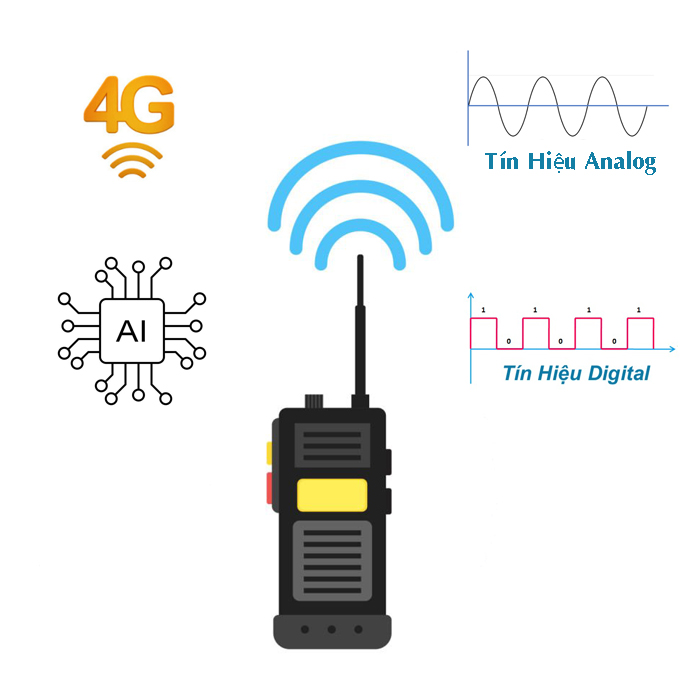
A two-way radio (or handheld two-way radio) is a wireless communication device widely used in many fields such as the military, industry, healthcare, transportation, security, and services. Today, to meet user needs and improve quality, two-way radios have adopted many modern technologies. From the original analog technology through to digital technology and 3G/4G mobile-network technology, let’s take a closer look at the technologies used in two-way radios today.
1. Analog Technology
An analog two-way radio is a device that transmits and receives audio as radio waves. Analog is the earliest technology, yet analog two-way radios are still trusted and widely used in the market today.
- Characteristics:
- A traditional technology that transmits audio as analog waveforms.
- Operates stably within a certain range, suitable for environments with little interference.
- Lower cost compared to digital two-way radios.
- Drawbacks:
- Audio quality degrades easily over long distances or in noisy environments.
- Low security — easy to eavesdrop on.
2. Digital Technology
- Characteristics:
- Converts audio signals into digital form, reducing noise and improving audio quality.
- Supports data transmission (such as text messages, GPS location) in addition to voice.
- Common standards: DMR (Digital Mobile Radio), NXDN, P25.
- Advantages:
- Better audio quality.
- Enhanced security through data encryption.
- Energy efficient, as it only uses spectrum when needed.
- Applications: Suitable for organizations that need secure and efficient communication.
3. Push-to-Talk over Cellular (PoC)
- Characteristics:
- Uses 3G, 4G, 5G mobile networks or Wi-Fi to carry the signal.
- No range limitation like traditional two-way radios.
- Advantages:
- Suitable for very large coverage areas.
- Supports features such as GPS positioning and communication history logging.
- Easy to integrate with management apps on smartphones.
- Drawback: Depends on the mobile network infrastructure.
4. Trunking Communication Technology
- Characteristics:
- Uses shared transmission channels for multiple user groups, optimizing the use of frequency resources.
-
- Common systems: TETRA (Terrestrial Trunked Radio), APCO-25.
- Advantages:
- Highly efficient in environments that need many communication channels.
- Better integrated security and management features.
- Applications: Used in public-safety communication systems, emergency services, or large organizations.
5. GPS and IoT Technology
- Characteristics:
- Combines GPS positioning and the Internet of Things (IoT) to provide location, monitoring, and device-management features.
- Lets users track the position of each two-way radio in the system.
- Applications: Fleet management, monitoring field staff.
6. Encryption and Security Technology
- Characteristics:
- Uses signal-encryption methods to prevent eavesdropping or unauthorized access.
- Common encryption standards: AES, DES.
- Advantage: Ensures privacy and information security.
7. AI and Machine Learning Integration
- Characteristics:
- AI helps improve audio quality (noise filtering, voice enhancement).
- Machine Learning helps predict system failures and optimize bandwidth.
- Applications: Enhances communication performance in complex environments.
8. Battery and Charging Technology
- Characteristics:
- Uses Lithium-ion batteries with high capacity and fast charging.
- Integrates energy-saving features and battery-status indicators.
- Advantage: Reduces communication interruptions caused by low battery.
Development trends:
- Integration with smart systems (IoT, AI).
- Expanded communication range thanks to mobile and satellite technology.
- Improved security and remote management capabilities.