 Chat with Us

What Are UHF and VHF Frequencies? UHF vs VHF Comparison
What Are UHF and VHF Two-Way Radios? Comparison, Applications, and How to Choose the Right One
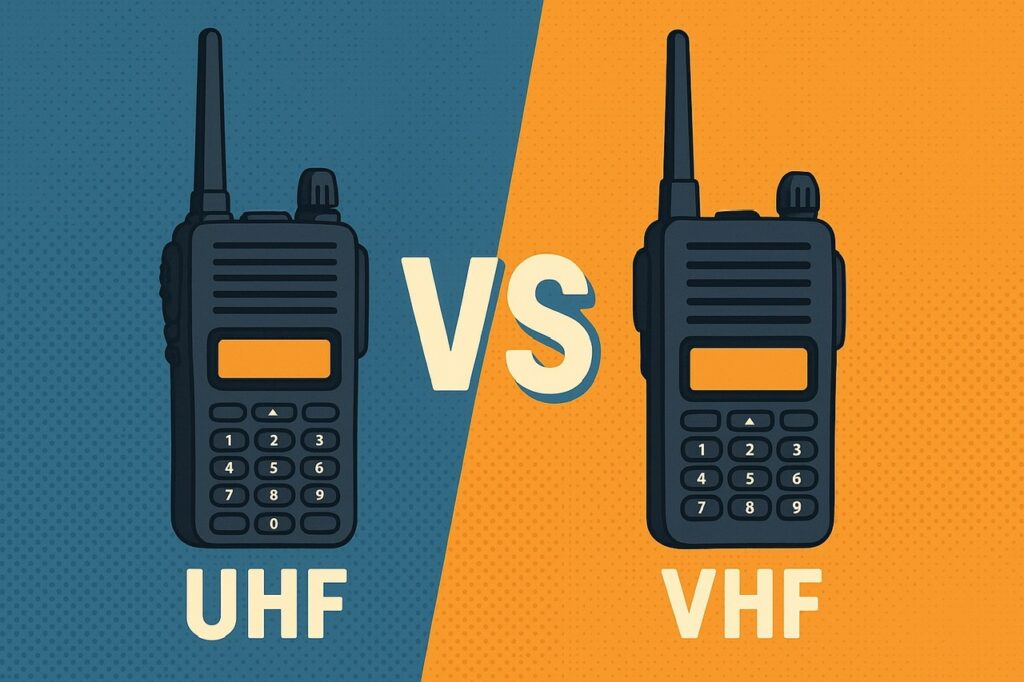
UHF and VHF two-way radios are the two most popular communication devices in use today. Although they share the same core function — transmitting information over radio waves — each one operates on a different frequency band, which leads to different effectiveness depending on the environment.
In this article, you will learn:
- ✅ What is a UHF two-way radio? What is VHF?
- ✅ The differences between the two types
- ✅ Real-world applications of each type
- ✅ Should you choose UHF or VHF for your needs?
1. What is a UHF two-way radio?
UHF (Ultra High Frequency) two-way radios operate in the 400 MHz to 520 MHz band. This higher frequency band lets signals pass through obstacles such as walls, concrete, and metal more effectively.
Standout characteristics:
- Penetrates walls well, with low signal loss in environments with many obstructions
- Well suited to cities, factories, buildings, and construction sites
- Most popular and easiest to find on the market today
2. What is a VHF two-way radio?
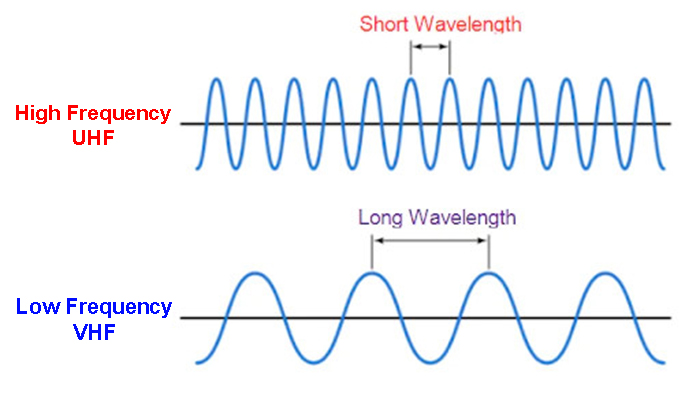
VHF (Very High Frequency) two-way radios operate in the 136 MHz to 174 MHz band. Because of the lower frequency, VHF waves can travel farther in open spaces but are more easily blocked by obstacles.
Standout characteristics:
- Longer-range transmission in open environments with no obstructions
- Good for communication in mountains, plains, agricultural areas, and at sea
- Signal quality drops sharply when encountering large obstacles
3. Detailed comparison: UHF vs VHF
| Criterion | UHF | VHF |
|---|---|---|
| Frequency band | 400 – 520 MHz | 136 – 174 MHz |
| Penetration through obstacles | Very good (passes through walls, glass, concrete) | Weaker, easily blocked |
| Transmission distance in open environments | 1 – 5 km | 3 – 15 km |
| Interference | Less interference, more channels | More affected by weather and interference |
| Applications | Inner city, buildings, security, construction | Agriculture, outdoors, maritime |
| Antenna size | Short, convenient | Longer (due to longer wavelength) |
| Price & availability | Widely available, many models | Fewer models, focused on specialized needs |
4. Real-world applications of each type
UHF two-way radio applications:
- Security at apartment complexes, shopping malls, and hotels
- Communication on construction sites and metal-rich factories
- Restaurants, bars, and event organization in the city
VHF two-way radio applications:
- Communication between fishing boats and crew members (maritime)
- Coordination on farms, plantations, and forests
- Outdoor activities, trekking, and other settings with no mobile phone signal
5. Should you choose UHF or VHF?
Choosing the right type depends on the environment you operate in and the communication distance you need.
✅ Choose UHF if:
- You use it in the city, in buildings, or in industrial zones
- There are many obstructions such as walls, glass, and concrete
- Communication distance is under 5 km
✅ Choose VHF if:
- You use it in open areas with no obstructions
- You work in agriculture, on boats, or in mountainous areas
- You want long-range communication (over 5 km) with few obstacles
⚠️ 6. Notes when buying UHF/VHF two-way radios in Vietnam
- Most professional two-way radios require frequency registration with the Authority of Radio Frequency Management
- For business use: choose devices with conformity certification
- Avoid Chinese two-way radios of unknown origin (they cause interference and may violate the law)
A UHF two-way radio cannot communicate directly with a VHF two-way radio; to bridge the two, a UHF-to-VHF converter is required.
7. Conclusion
| Operating environment | Recommended |
|---|---|
| Indoors, construction, urban | UHF |
| Outdoors, forest, sea, agriculture | VHF |
Whether you are an individual user or representing a business, choosing the right two-way radio will help you:
Communicate effectively and reliably ⚡ Save on costs