 Chat with Us

Two-Way Radio Communication Range: Understanding It for Effective Use
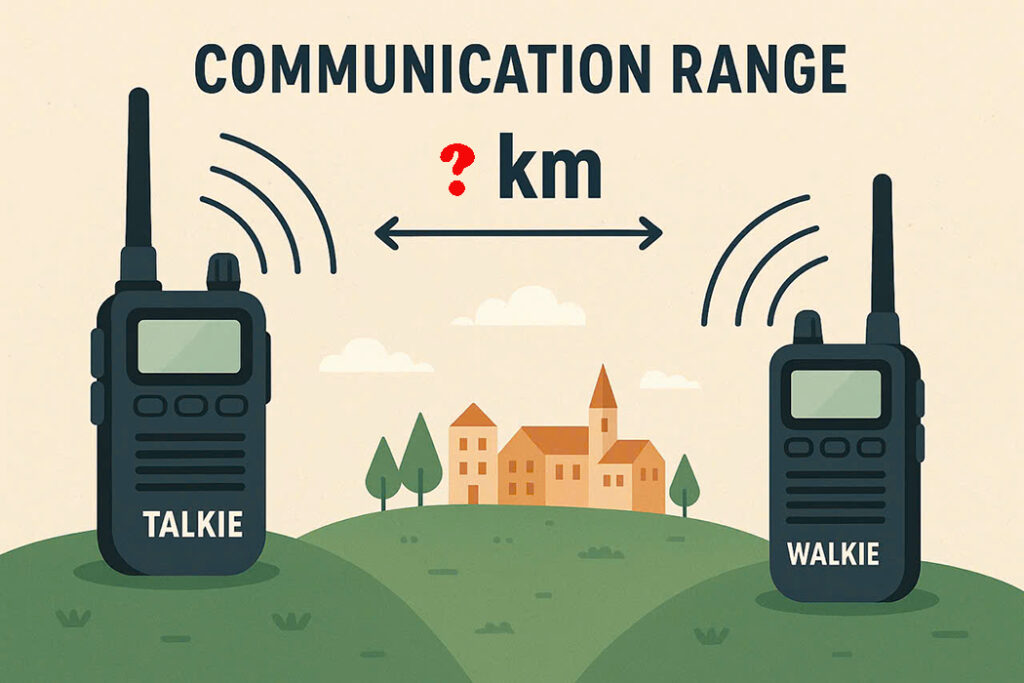
Two-way radios are an important wireless communication device in many fields such as security, construction, maritime, event organization, and outdoor activities. However, one common question puzzles many people: how far can a two-way radio actually communicate? This article gives you a complete, easy-to-understand, and accurate answer, plus tips on how to extend the usable range.
1. Two-way radio range: there is no fixed number
In reality, there is no single absolute communication distance that applies to all two-way radios. The range depends on many factors, including:
- Output power
- Geographic environment (city, mountains, sea, etc.)
- Obstacles (high-rise buildings, concrete walls, etc.)
- Type of frequency used (UHF or VHF)
- Antenna quality and height
Illustrative example:
| Power | Dense urban area | Open area, clear terrain |
| 1 W | 300 – 800 m | 1 – 1.5 km |
| 5 W | 1 – 2.5 km | 3 – 6 km |
| 25 W | 1 – 5 km | 5 – 10 km |
| With a Repeater | 3 – 7 km | 5 – 20 km |
2. VHF vs UHF: the frequency type determines the reach
- VHF (Very High Frequency — 136~174 MHz):
- Good for rural areas and open terrain with no obstructions.
- Signal travels farther but struggles to pass through obstacles.
- UHF (Ultra High Frequency — 400~470 MHz):
- Suitable for urban environments, high-rises, and areas with many obstructions.
- Wavelength is shorter than VHF, but penetration is better.
Tip: If you are using two-way radios in a factory, shopping mall, or construction site, prioritize UHF. For outdoor use, choose VHF.
3. Factors that affect range
- Two-way radio output power:
- Higher power means longer transmission, but it must comply with legal regulations.
- Antenna:
- Antenna length and quality matter a great deal.
- A detachable antenna mounted on a vehicle or repeater is always stronger than a handheld antenna.
- Terrain:
- Obstacles such as hills, high-rise buildings, and trees have a significant impact.
- Interference:
- Areas crowded with wireless devices will substantially reduce range.
- Weak battery:
- When the battery is low, transmit power drops → communication range shrinks.
4. How to extend two-way radio range
Don’t rush to replace your two-way radio! Try these solutions first:
✅ Raise the antenna:
- Mount an external antenna above head height or on the roof.
- For vehicle-mounted radios, use a 5/8-wave antenna or a magnetic antenna.
✅ Use a Repeater:
- Placed at a high location, a repeater can extend coverage by tens of kilometers.
- Ideal for large factories, high-rise buildings, or mountainous areas.
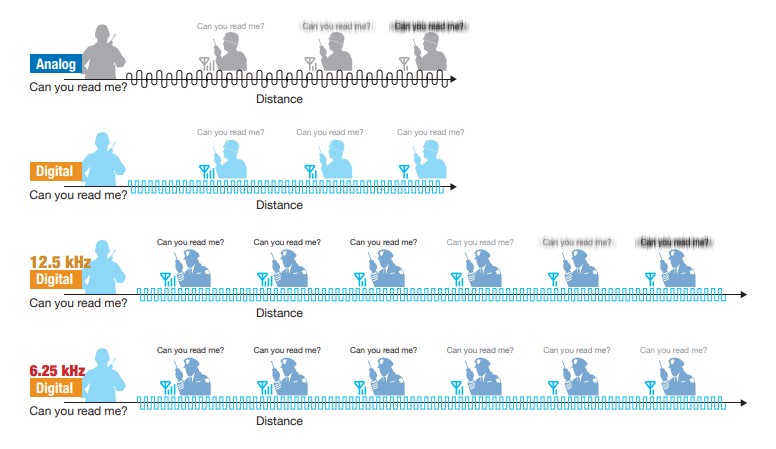
✅ Use Digital Radio (DMR/NXDN):
- Strong noise rejection and longer transmission under the same conditions compared with analog.
- Clearer audio and better data transmission.
5. Frequently Asked Questions (FAQ)
“Can a 5 W two-way radio reach 10 km?”
Possibly, if:
- The environment is open (sea, plains, high ground)
- A high-quality antenna is mounted
- Combined with a repeater or external antenna
“Why does my 5 W two-way radio only reach 1 km?”
- Being used in an area with many obstructions (concrete walls, high-rises)
- Signal is intermittent due to interference from electronic devices
- Weak battery or unsuitable antenna
“Do I need to register the frequency?”
- Yes! As required by Vietnam’s Authority of Radio Frequency Management.
- Registering the frequency helps avoid interference, ensures stable signals, and keeps you compliant with the law.
6. Conclusion
There is no absolute number for two-way radio range. To optimize communication, you need to understand the characteristics of the device, the environmental conditions, and how to improve performance when needed. With the knowledge above, you can choose the right model and the right approach to keep a stable connection.