 Chat with Us

5 Reasons Businesses Should Use Two-Way Radios Instead of Mobile Phones
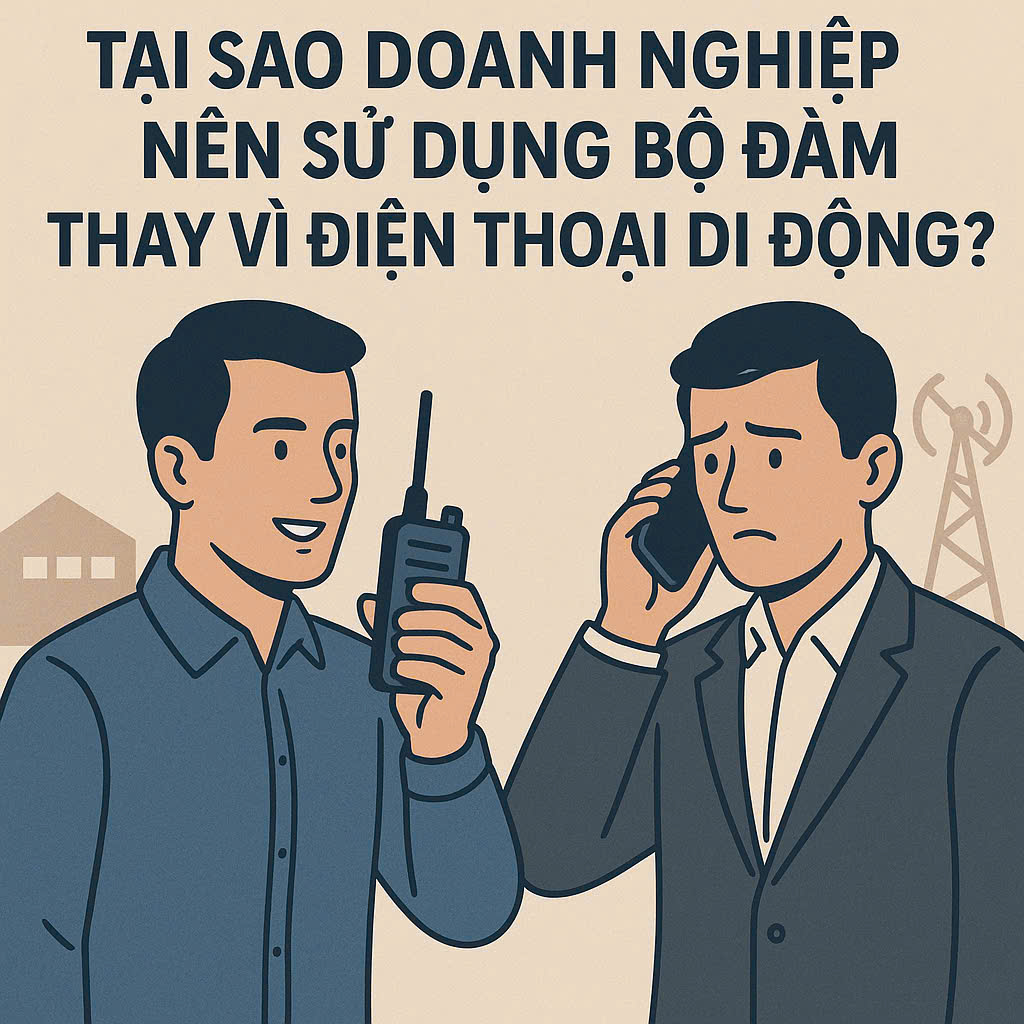
Is your business still using mobile phones for internal communication?
In many businesses today — from security companies, restaurants, and hotels to factories and construction sites — mobile phones are still used as the primary communication tool. However, mobile phones are not the optimal solution for fast-paced teamwork or workflows that require constant communication.
Two-way radios are a worthwhile alternative, offering outstanding convenience, reliability, and cost savings. Below are 5 reasons more and more businesses are switching from mobile phones to two-way radios.
1. Instant communication — no waiting to connect
With a two-way radio, you simply press the PTT (Push-to-Talk) button to communicate immediately — no dialing or waiting for someone to pick up like a phone. In environments that demand fast response, such as security, manufacturing, logistics, and restaurants, instant transmission can help prevent risks or resolve issues in time.
Two-way radio
communication can be 5–10 seconds faster per call than a mobile phone.
2. No call charges, all-day battery life
Two-way radios do not charge per call. You only need to register the frequency fee and you can communicate without limits on call count or duration during the day. In addition, two-way radio batteries can run continuously for 8–12 hours, with some models reaching 24 hours. Mobile phones, on the other hand, drain quickly with continuous use and rack up voice/3G/4G charges.
Save millions of VND per month compared with paying for staff to use personal mobile phones..
3. Durable — works well in harsh environments
Two-way radios are designed to withstand drops and resist water and dust, making them well suited to:
- Factories, construction sites, warehouses
- Resorts and large hotels
- Construction and event security
Many models meet IP54/IP67, far exceeding the durability of an ordinary mobile phone.
️ Real-world example:
A 15-story construction site using UHF two-way radios maintains normal floor-to-floor communication, while mobile phones lose signal in the basement.
4. Group communication — easily manage multiple teams at once
Two-way radios support group calls, so the whole group hears at the same time when someone speaks. This is extremely effective in:
- Internal security operations
- Event organization
- Assigning production tasks
With a single action, a manager can communicate to 5–10 people at the same time.
5. Stable operation — no dependency on mobile networks
In low-signal environments such as:
- Basements
- Industrial zones far from the city center
- Areas with no mobile phone signal
Two-way radios still work well thanks to their dedicated frequencies. With high-power two-way radios or a repeater, the communication range can reach 3–5 km within the city and 10–20 km in open areas.
Conclusion
Equipping your business with two-way radios is a fast, cost-saving, and effective communication solution, well suited to fields such as:
- Security
- Restaurant and hotel management
- Factory and warehouse operations
- Events, tourism, and logistics
If your business is still using personal mobile phones for internal communication, consider investing in two-way radios to save costs, boost productivity, and make your operations more professional.