 Chat with Us

Analog vs Digital Two-Way Radio Comparison
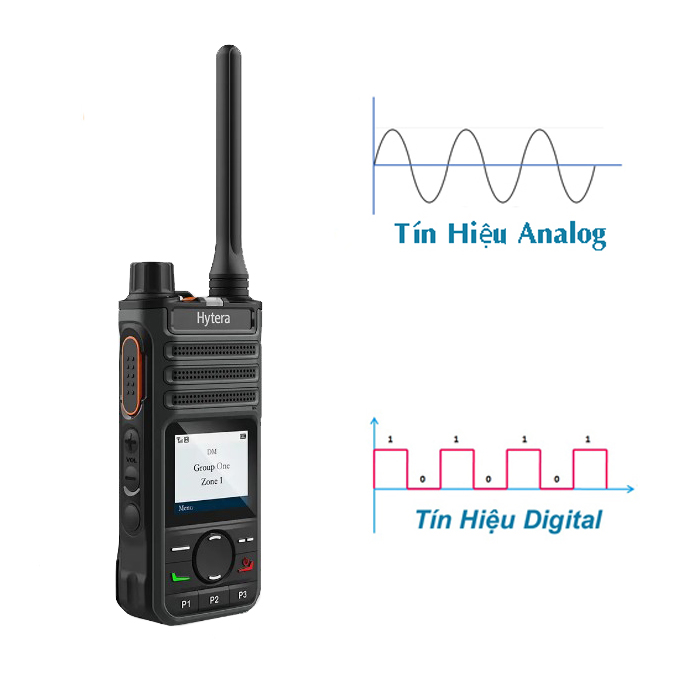
Analog vs Digital Two-Way Radios: Why You Should Move to Digital
For many years, analog two-way radios have been the workhorse communication device in industries such as security, construction, and warehousing. With the rapid growth of digital technology, however, digital two-way radios are gradually replacing analog ones thanks to a long list of superior features. So what are the differences between the two, and why should you choose a digital two-way radio?
1. How they work
| Criterion | Analog two-way radio | Digital two-way radio |
| Signal transmission | Transmits audio as an analog waveform | Encodes audio into digital data |
| Audio quality | Degrades with distance | Stays clear right up to the edge of coverage |
| Group communication | 1 call at a time | Can split channels and make flexible group calls (DMR Tier II) |
2. Audio quality
- Analog: audio degrades with distance and is prone to noise when the signal is weak.
- Digital: audio is crisp and stable, with no background noise even at the edge of the coverage area.
With digital, listeners always hear voices as if the speaker were nearby, thanks to encoding and error correction (FEC – Forward Error Correction).
3. Battery efficiency
- Digital uses battery more efficiently thanks to TDMA (time-division multiplexing).
- For example: a two-way radio like the Hytera BP518 can operate up to 21 hours in digital mode, compared with about 16 hours in analog mode.
4. Security and encryption
- Analog is easily eavesdropped on by another two-way radio on the same frequency.
- Digital supports voice encryption, providing strong security for businesses, security teams, and law enforcement.
5. Advanced features
| Feature | Analog | Digital |
| Group call, Private Call | ❌ Not supported | ✅ Yes |
| Text messaging | ❌ Not supported | ✅ Yes |
| Priority call / emergency alert | ❌ Very limited | ✅ Fully supported |
| GPS / Bluetooth / VOX integration | ❌ Limited | ✅ Many models supported |
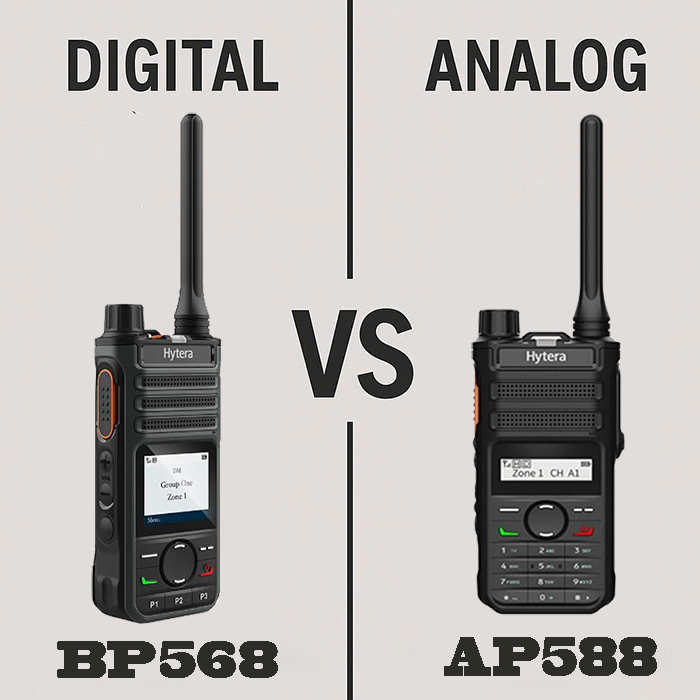
| Pseudo Trunk / Trunking | ❌ Not supported | ✅ Yes (depending on model, such as the Hytera BP568) |
6. Why choose a digital two-way radio?
- Clearer and more stable audio
- Better battery life
- Support for advanced features like group calls, location, encryption, and more
- Easy to scale into a professional system (Trunking, Digital Repeater, IP Connect)
⚠️ Digital two-way radios usually cost 15–30% more than analog, but they are absolutely worth it for serious working environments that demand high reliability.
️ When does analog still make sense?
- Small environments, few users, no security requirement
- Tight budgets
- Existing analog systems that are already running smoothly
✅ Conclusion
If you are a growing business that needs effective, secure, and clear communication, a digital two-way radio is the optimal choice. Don’t let outdated equipment drag down your team’s performance!
Recommended products:
- Hytera BP518/BP568: Pseudo Trunk support, digital + analog, strong battery life, reasonable price
- Kenwood NX1300/NX1200: Durable, well suited to construction sites and factories